![Slideform_logo_master-1.png]](https://helpcenter.slideform.co/hs-fs/hubfs/Slideform_logo_master-1.png?width=50&height=50&name=Slideform_logo_master-1.png)
The best prompts are specific, business-focused, and tied to a clear output.
Prompt writing tips:
-
Start with one business question.
-
Include a date range.
-
Name the metric clearly.
-
Ask for a specific output type.
-
Save strong results as reusable insights.
Use the examples below as starting points for your own Slideform Data Analysis Assistants.
Calculate Metrics or KPIs
- Prompt: "How many closed won deals have a close date of this calendar month?"
Output Type: Text
Data: HubSpot data source. Select the Deals worksheet and Deals table. Add any filters that should be applied. - Prompt: "What was the percent change in total rent from 2025 to 2026?"
Output Type: Text
Data: Google Sheet
Generate text, bullet points, and takeaways
- Prompt: "Which property had the lowest star rating in 2024?"
Output Type: Text
Data: Google Sheet
- Identify a trend in the data
Prompt: "Examine the number of impressions per week over the past 6 months. Identify any upward or downward trends in the data relative to the baseline expectation of 10,000 impressions per week."
Output Type: Text
Data: Looker Studio dashboard
Create Data Tables
- Generate a table summarizing data from a database
- Prompt: "Create a summary table showing the count of properties that had an occupancy rate higher than 50% in each year. The data table should have columns for year and number of properties."
Data: Airtable, spreadsheet, or database connection. Add any filters that should be applied in order to limit the data volume sent to the AI. - Output Type: Table
Year Number of Properties 2023 17 2024 12
- Prompt: "Create a summary table showing the count of properties that had an occupancy rate higher than 50% in each year. The data table should have columns for year and number of properties."
- Create a table of records
Prompt: "Create a table of closed won deals that have a close date during last week. My week begins on Sunday and ends on Saturday. Show the Deal name, amount, and close date columns. Format the Amount as a dollar value."
Output Type: Table
Data: HubSpot or other CRM data source. Select the Deals worksheet and Deals table. Add any filters that should be applied.
Result: An editable table that can be inserted into any report or presentation slides.
| Deal Name | Amount | Close Date |
| VBC of America | $1250 | 2025-08-05 |
| Alpha Systems | $500 | 2025-08-07 |
| Optum Services | $1250 | 2025-08-08 |
Create Charts
- Create a chart with data from Salesforce
- Prompt: "Create a bar chart showing the number of open opportunities by Stage. Remove the legend. Make the x-axis labels diagonal so they are readable and non-overlapping."
- Output Type: Chart
- Data: Salesforce Opportunities Table
- Result:
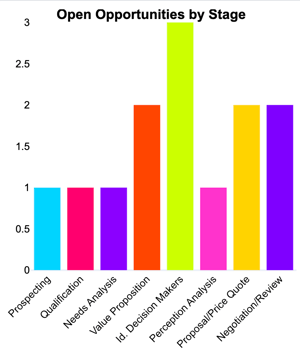
Tip: Chart colors and styling can be set in the AI Assistant Settings.
- Make a new version of a chart from a dashboard
- I want to extend the date range of this chart to the past 3 months and I want to group the data by week rather than by day. Finally, I want to change the color scheme and styling to match my company branding.
Original chart: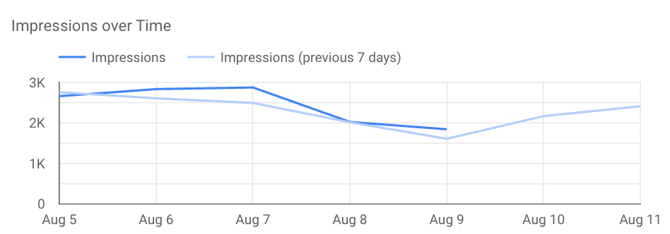
Prompt: "Create a line chart of the number of impressions each week over the past 3 months."
Output Type: Chart
Data: Looker Studio dashboard of Google Search Console data. Select the correct table for Impressions over Time. Filter to the appropriate date range.
Result: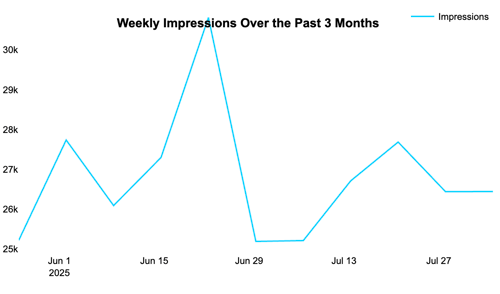
- I want to extend the date range of this chart to the past 3 months and I want to group the data by week rather than by day. Finally, I want to change the color scheme and styling to match my company branding.